
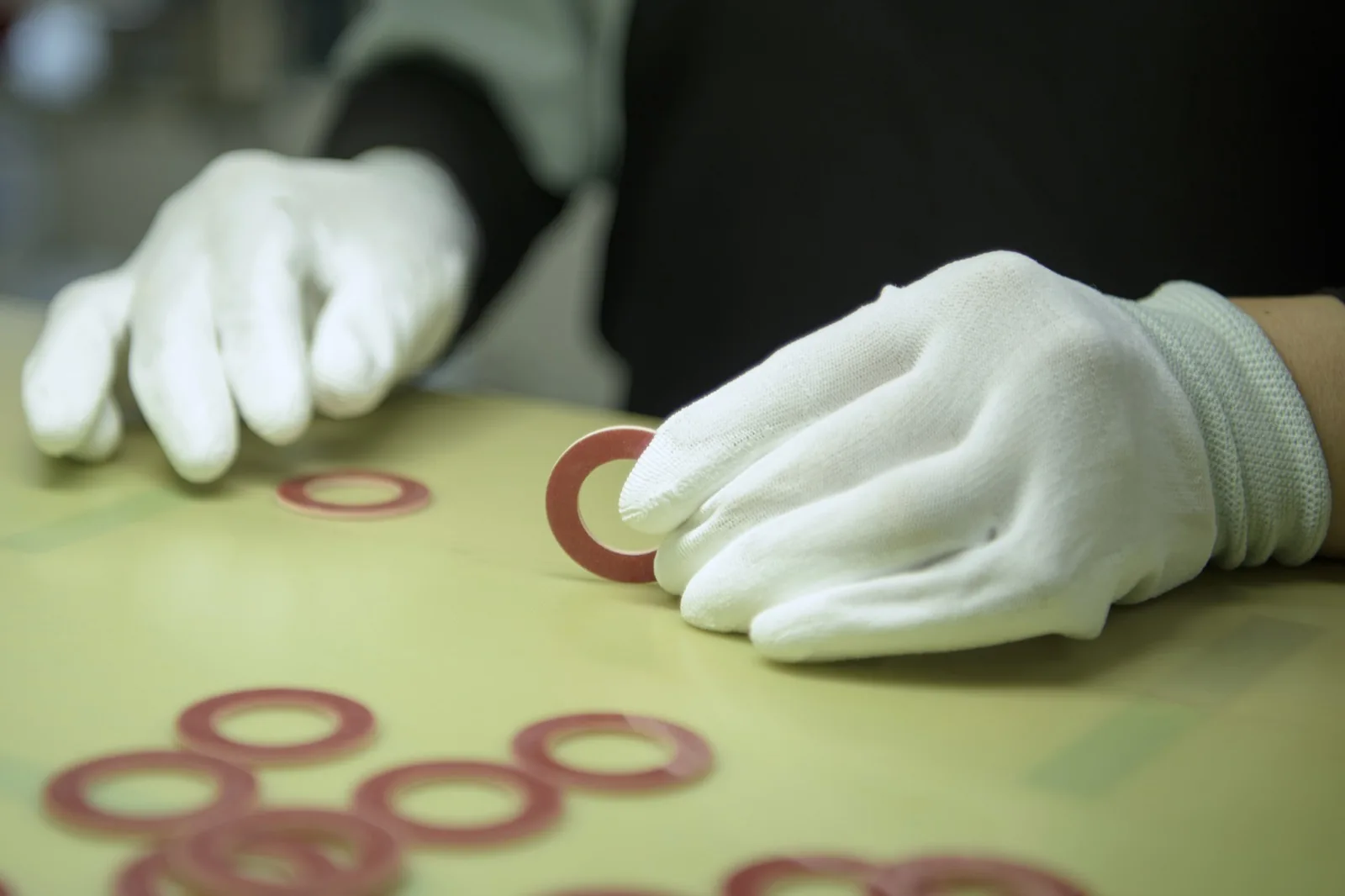
Since we cannot publish actual processing examples, we will present a hypothetical case.
A case where automation for efficiency was deliberately not chosen: Because it's a special material. Towards the optimal process that protects quality.
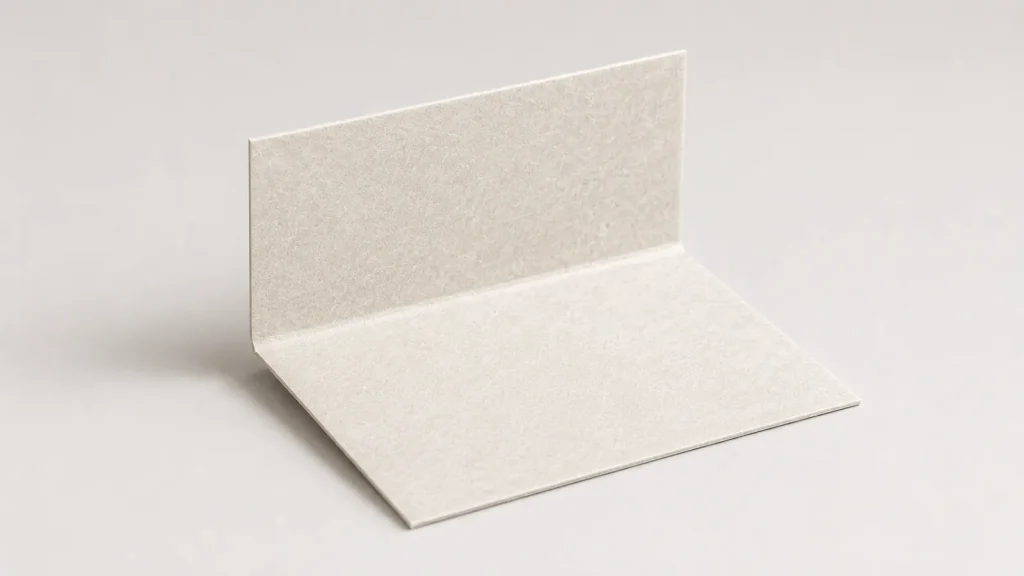
overview
Starter-related parts made from a special resin (Nomex).
Aiming to improve productivity, we tackled the challenge of improving the folding process.
Although we considered bending the product within the mold, we decided against it due to concerns about its impact on the product surface.
This is an example of achieving both quality and productivity by redesigning the process to a manual bending process using dedicated jigs.
I want to improve efficiency. But Nomex can't be bent easily.
Nomex is a special material used in starter-related parts.
This aramid fiber material boasts excellent heat resistance and insulation properties, and is used in products that operate in harsh environments, such as electrical components.
On the other hand, because it has different properties from general resin materials, initially, after scoring and punching using molds, manual bending by workers was performed during the inspection process.
However, with the increase in order volume, the manual bending process became a challenge in improving production capacity.
"Can we evolve towards more efficient production methods while maintaining quality?"
Leveraging our resin press processing technology, we have begun a new challenge to improve our processes.
We won't compromise on quality or productivity. We're searching for the answer.
Faced with the challenge of improving productivity, sales representative T listened to customer feedback.
"We want to achieve more efficient production methods while maintaining quality."
Engineer T, having received this feedback, began considering the optimal processing method, taking into account the characteristics of the special material called Nomex.
[First Challenge] The dimensions were acceptable. But why couldn't we use it?
The first thing we tackled was a processing method that completed the bending process within the mold.
We explored the possibility of increasing production efficiency by consolidating processes.
As a result of the prototyping process, dimensional accuracy was achieved.
However, contact with the mold caused scratches on the product surface, preventing it from meeting the required quality standards.
[Second Challenge] Deliberately opting for manual labor. A revolutionary approach that balances quality and productivity.
The processing capabilities and the required quality are not necessarily the same thing.
Engineer T prioritized quality above all else and decided against using the in-mold bending process.
The solution chosen was to redesign the process to utilize specialized jigs for manual bending.
Instead of simply reverting to conventional methods, we developed jigs to improve work efficiency.
This enables stable processing, reducing processing time and improving production efficiency while maintaining quality.
Trust that has lasted for over 30 years. Behind it lies in the ingenuity and challenges of those working on the front lines.
Sales representative T's desire to "address our customers' challenges."
Engineer T's challenge: "Find the optimal method."
That accumulation of effort has led to a stable supply and trust that has continued for over 30 years.
It's not just about efficiency. It's about the technical judgment that has supported over 30 years of trust.
What this initiative has achieved is more than just a reduction in working time.
The optimal processing method that engineer T arrived at after much trial and error.
Through this process, we established a method that improves production efficiency while maintaining quality.
Process improvements using specialized jigs reduce working time and achieve consistent processing quality.
By understanding the properties of Nomex, a special material, and selecting processing methods that prioritize product quality, we have been able to maintain stable mass production and delivery for over 30 years.
We don't just pursue efficiency; we uphold the quality our customers expect.
That technical judgment and accumulated experience have led to the trusting relationship that continues to this day.
Making it quickly isn't always the right answer.
In manufacturing, the most important thing is not just "making things quickly."
Quality, productivity, and cost.
It is important to determine the right balance between each element and choose the optimal processing method for that particular product.
Yamada Manufacturing doesn't just manufacture according to blueprints; we address our customers' challenges and work together to find the optimal manufacturing solution.
From a single component, to a better future of production.
That's how we at Yamada Manufacturing Co., Ltd. approach manufacturing.
Contact
For inquiries, please use the "CONTACT" link in the footer at the bottom of the page.
You can contact us via email, LINE, or phone.