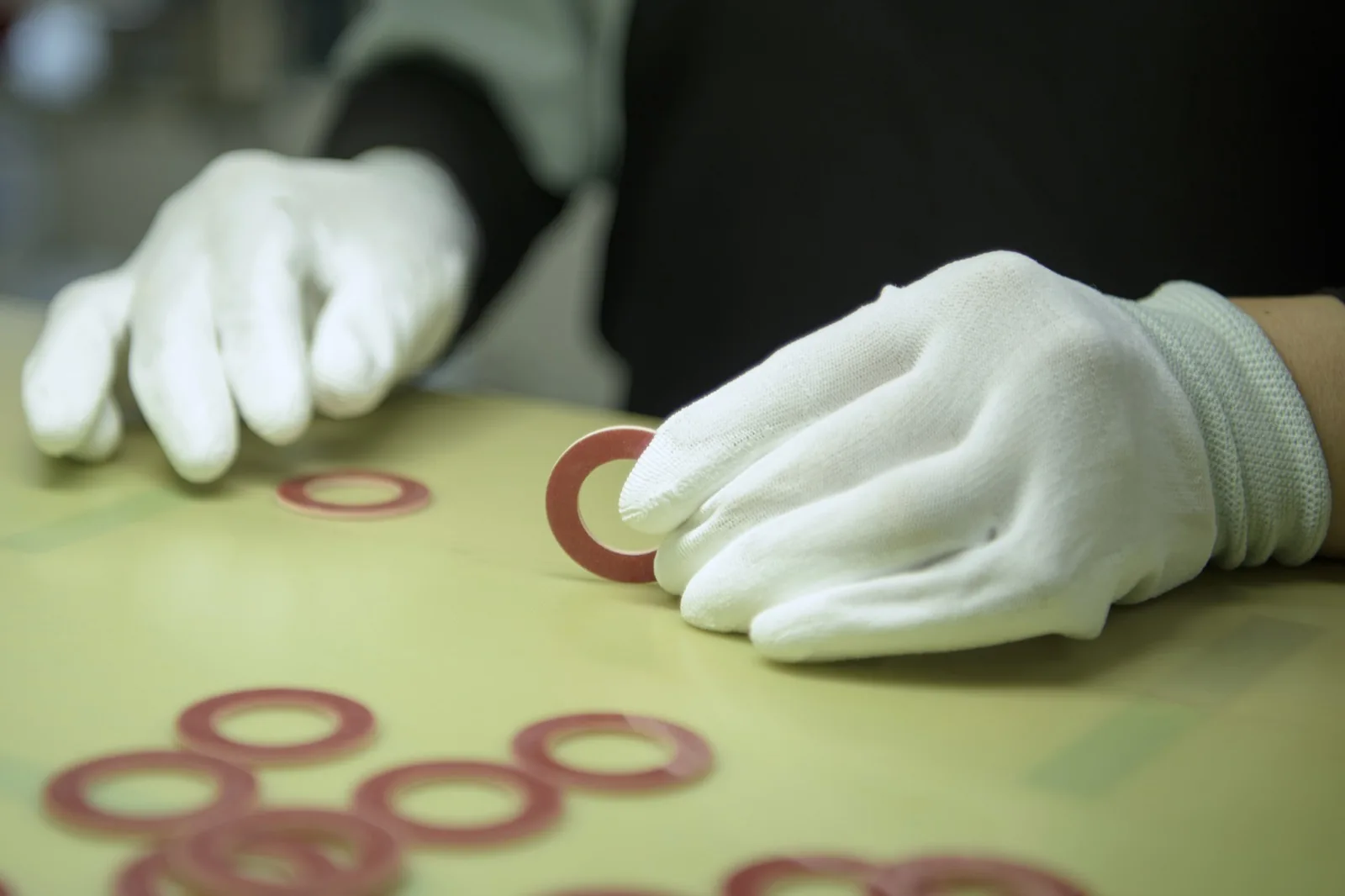
Since we cannot publish actual processing examples, we will present a hypothetical case.
Case study of process design and mass production stabilization to improve warping defects in PET film.
overview
We implemented process improvements based on material properties to address the warping defect in PET film washers.
Focusing on the warping over time caused by the inherent curling characteristics of rolled materials, we implemented comprehensive measures that included not only a review of processing conditions but also production timing, inventory management, and packaging methods.
This is an example of how production design, which takes material changes into account, has enabled the stabilization of quality and the establishment of a mass production system.
Background and challenges: The washer appears normal immediately after processing. However, warping defects still occur.
Washer warping defects occurred during the mass production process. Improvements were needed to stabilize quality.
The PET film used in this product is supplied in roll form.
Therefore, the material retained a curling tendency, and even if there were no problems immediately after pressing, it had the characteristic of gradually warping over time as storage progressed.
Simply adjusting processing conditions was not enough to maintain consistent quality; the major challenge this time was to confront the changes in the material itself over time.
We review our customers' problems from the perspective of the entire process.
Upon hearing about the customer's challenges, sales representative T explored ways to resolve them.
"We want to deliver products that offer consistent quality and can be used with confidence."
Inspired by this sentiment, engineer T considered improvement methods from a new perspective.
"We need to consider not just the processing, but also the materials, production, and storage."
Thus began our challenge to improve the entire process.
[The First Challenge] Heat treatment was introduced to suppress warping. However, a new problem arose...
The first thing we tackled was aging through heat treatment.
We aimed to reduce warping by mitigating the distortion remaining within the material.
While we were able to confirm some improvement, a new challenge arose: increased costs due to the addition of a process.
[Second Challenge] Changing materials didn't work. A revolutionary idea to overcome the warping problem.
Next, we focused on the material properties inherent in the PET film itself.
In collaboration with material manufacturers, we investigated the effect of winding memory on warping by changing the winding direction of the roll material.
Although some improvement was achieved, there were limitations to long-term stability, so we will change our approach.
"Instead of stopping the material's changes, process it before it changes."
We have changed our operations to perform press processing as soon as possible after receiving materials, and to manage inventory in the finished product state.
By avoiding long-term storage of raw materials, we have established a production system that suppresses warping over time and maintains stable quality.
[The Third Challenge] It doesn't end with processing. We're devising innovative delivery methods to ensure quality.
Furthermore, we also focused on maintaining quality at the time of delivery.
Conventional bagging methods presented challenges in ensuring the products remained aligned and warped during transport.
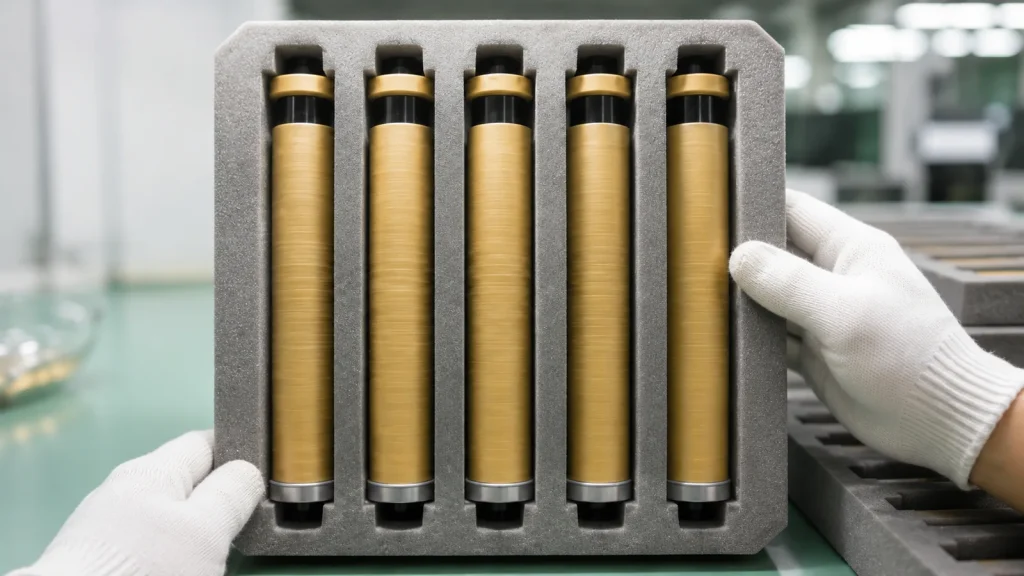
Therefore, we discussed the specifications with the customer, jointly designed a dedicated case, and created a structure that can hold the product in a straight line, thereby improving the ability to check for warping and preventing foreign matter from entering.
We have perfected a system to ensure quality from processing to delivery.
The photo at the beginning of this article is of that product.
Results: Up to 2 million units per year. Mass production system supported by quality improvements.
By improving processes and reviewing production operations based on material properties, we have successfully suppressed warping defects on a stable basis.
Furthermore, we have established a quality control system that includes inventory management in the product state and the design of dedicated packaging.
As a result, our annual production volume, which was previously around 200,000 to 300,000 units, was able to handle deliveries of up to 2 million units without any problems.
We continue to use the same specifications, maintaining a stable quality and supply system.
Identify the root cause of the problem and build the optimal production system.
This improvement is not simply about eliminating the warping problem.
We reviewed the entire process, from material properties and production timing to inventory management and packaging methods, and built a system that ensures stable quality.
We investigate "why defects occur" and consider not only the individual product but also the processes beyond that.
That's Yamada Manufacturing's approach to manufacturing.
We address each customer's specific challenges and propose the optimal processing methods and production systems.
For inquiries, please contact us here.
Contact
For inquiries, please use the "CONTACT" link in the footer at the bottom of the page.
You can contact us via email, LINE, or phone.