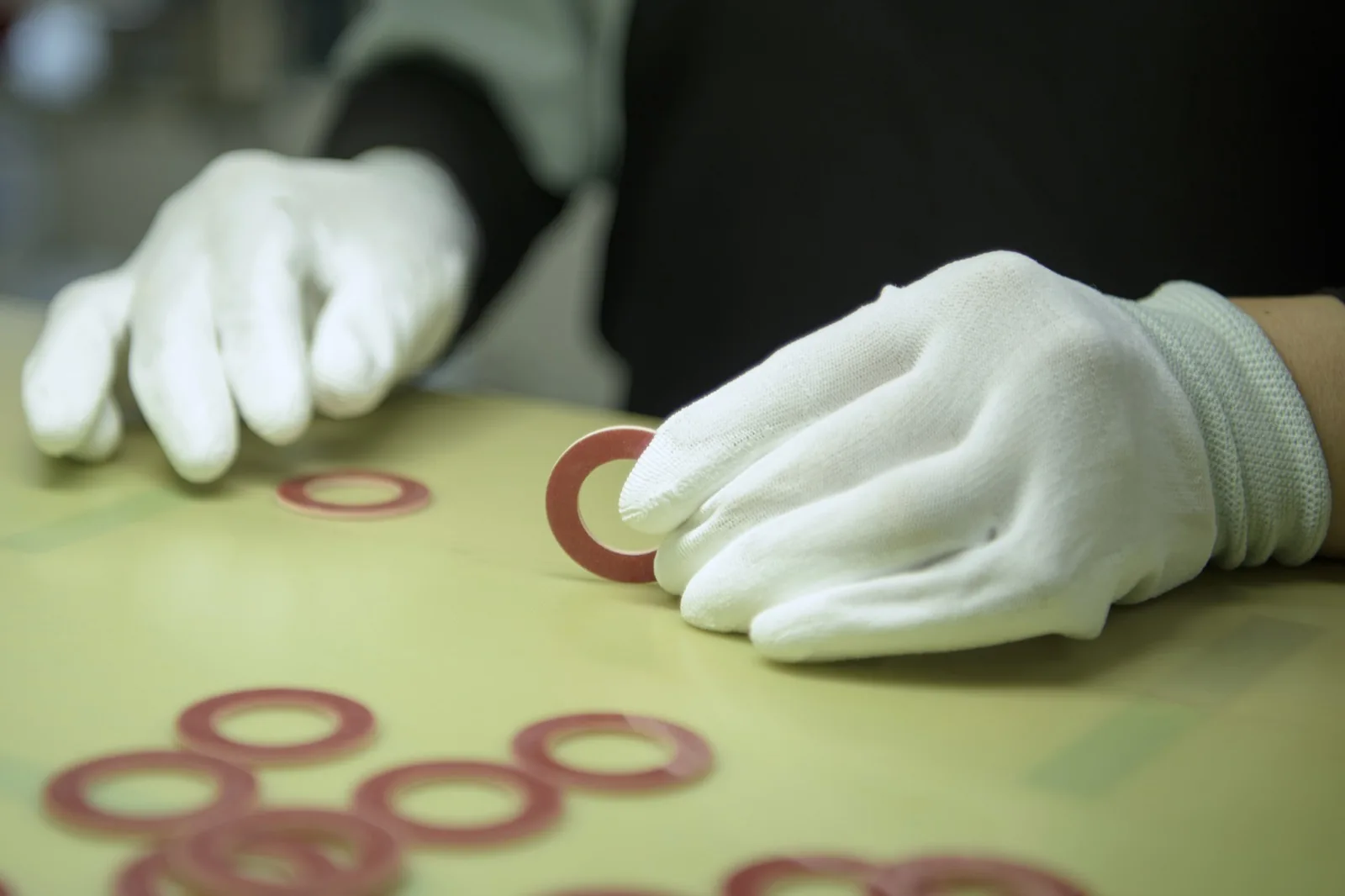
Since we cannot publish actual processing examples, we will present a hypothetical case.
Process reforms that enabled a 100-fold increase in production
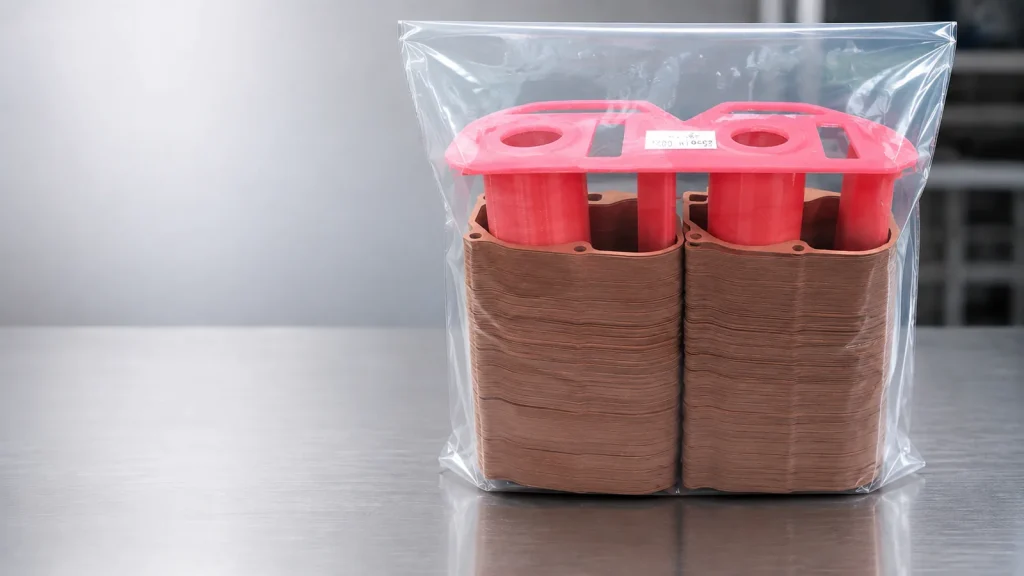
overview
We decided to mass-produce waterproof gaskets for automotive parts, and therefore switched our processing method from die cutting to die press working.
We combined this with process automation using alignment jigs developed in-house.
This is an example of establishing a mass production system that achieves both stable supply and labor savings by significantly increasing production capacity from 2,000 units per month to 200,000 units while maintaining quality.
Can you produce 200,000 units with the same delivery time and cost?
The joyous increase in orders also marked the beginning of a major challenge.
The manual labor that we have continued to use to maintain quality is reaching its limits as production volume increases rapidly.
"At this rate, we won't be able to meet our customers' expectations."
We were forced to make the decision to change our production methods themselves.
Approach to the solution
While we feel a sense of responsibility for receiving mass production orders from our customers, we realize that our current methods have their limitations.
However, "We want to meet our customers' expectations no matter what."
Faced with the demand for a monthly production of 200,000 units, sales representative T and engineer F took on the challenge of building a new mass production system.
[STEP 1] The mass production system was resolved by changing the construction method, but a problem arose!
The first thing we tackled was switching from die cutting to die press working.
To ensure stable mass production of thin, easily breakable products, we adopted a push-back type design.
Pushback is a method of fitting the product into the material immediately after the product shape has been formed.
By designing a process that involves sending the material back and then separating it again, we achieved both quality and productivity.
This successfully paved the way for mass production.
However, a new problem emerged: the products, once collected in the boxes, would become entangled and break.
[STEP 2] Engineer F develops a unique automated alignment system.
Engineer F was the one to take on the next challenge.
We developed an automatic alignment system at the exit of the press machine using a dedicated jig tailored to the shape of the product.
By automating the entire process from punching to alignment, we significantly reduced manual work, resulting in fewer defects and improved production efficiency.
The product in question is shown in the top photo of this article.
Towards a production line that exceeds expectations
The sales team's desire to "respond."
The challenge of "realizing" technology.
With their shared vision united, a production line was completed that balances quality and mass production efficiency.
results
What awaited us at the end of this challenge was even greater trust with our customers.
By changing manufacturing methods and automating processes, we have established a stable supply system capable of producing 200,000 units per month.
We achieved uniform quality through high-precision processing and improved production efficiency through labor-saving measures.
We continue to deliver products in a condition free from breakage or deformation, ensuring a stable supply without interrupting our customers' production lines.
This initiative has led to a relationship of trust that continues to this day.
For any concerns regarding manufacturing method changes or mass production, contact Yamada Manufacturing Co., Ltd.
This case is not simply a change in construction methods.
This is a manufacturing challenge where we confront our customers' challenges and work together as a team of sales and technical staff to find solutions.
Yamada Manufacturing doesn't just manufacture according to blueprints; we work with our customers to determine the optimal production method.
From a single blueprint, we'll transform the future of production.
That's how we at Yamada Manufacturing Co., Ltd. approach manufacturing.
Contact
For inquiries, please use the "CONTACT" link in the footer at the bottom of the page.
You can contact us via email, LINE, or phone.