
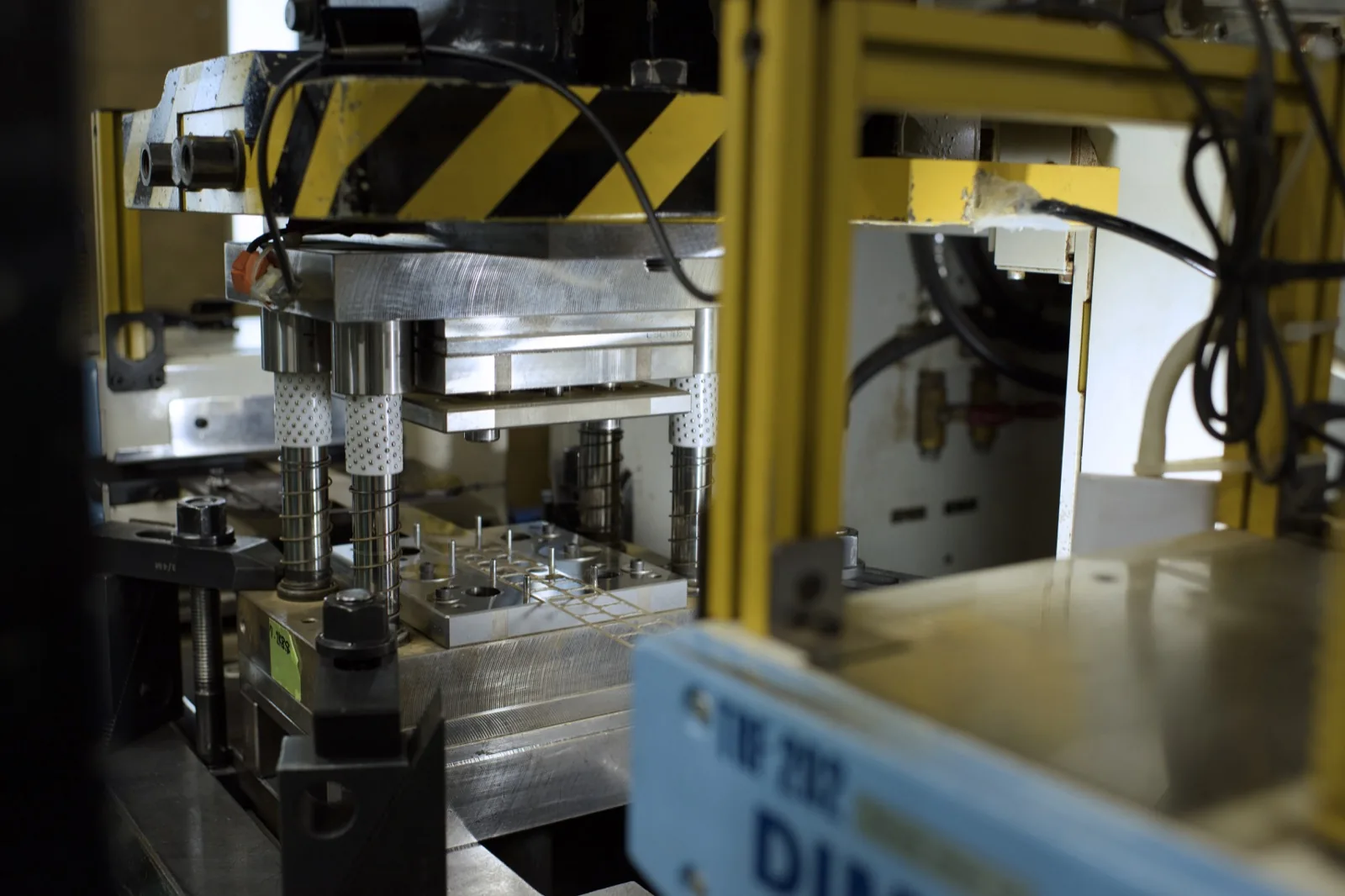
What kind of company is YAMADA INDUSTRIES CO.,LTD.?
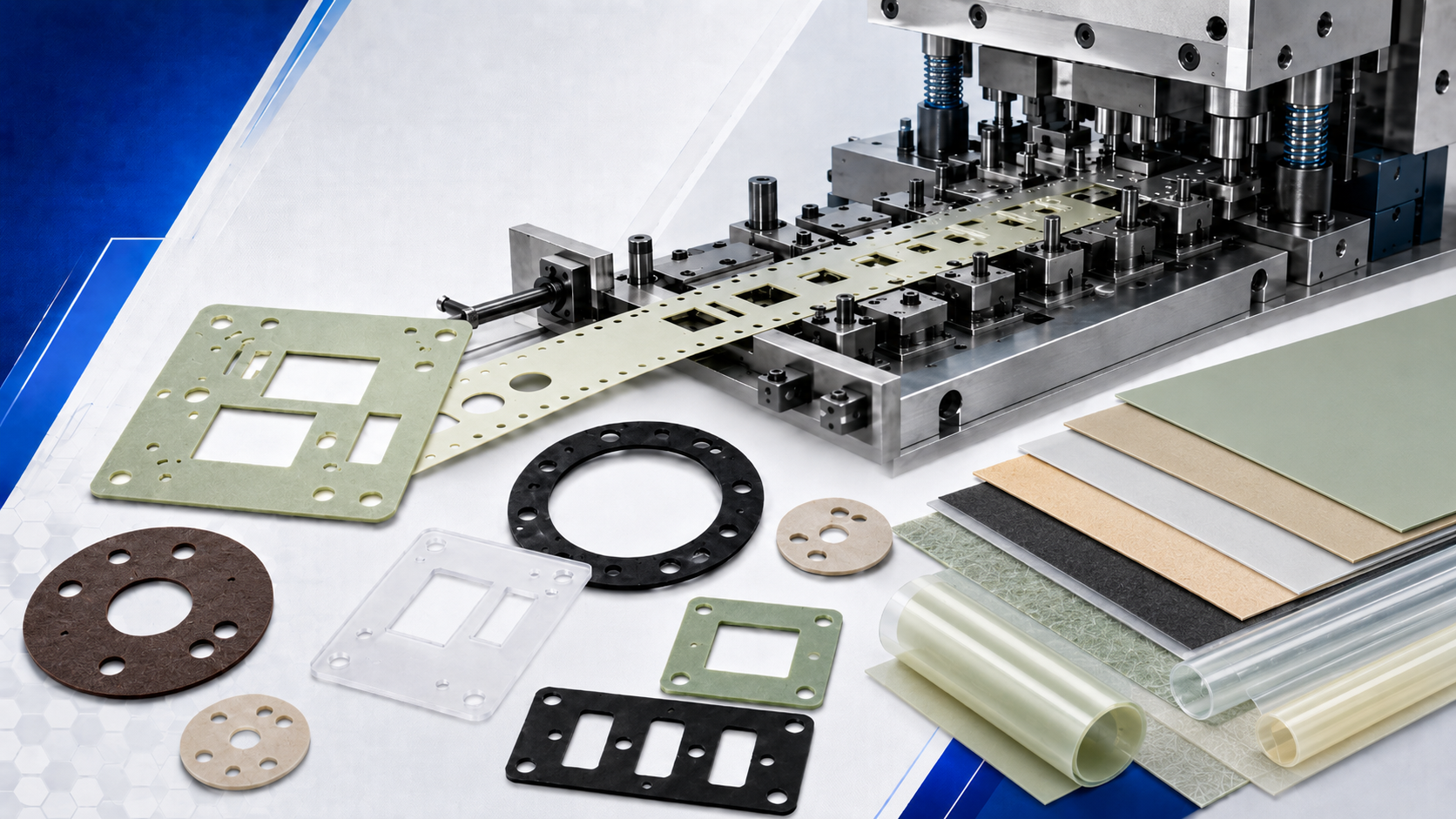
What kind of company is Yamada Manufacturing?
YAMADA INDUSTRIES CO.,LTD., based in Kariya City, Aichi Prefecture,Insulating materials and resinsWe are a manufacturer specializing in die-cutting.
Are you experiencing concerns about dimensional accuracy, delamination, or challenges in mass production startup when punching out insulating materials and resins?
At Yamada Manufacturing, we optimize mold design and processing conditions based on an understanding of material properties.High precision, short lead times, and stable mass production.This has been achieved.
What is punching out insulation material?
There are mainly three types of press working:
- Separation process (cutting)
- Molding (shaping)
- Joining and assembly
Our company specializes in **punching (separation) insulating materials**.
Basic principles of punching
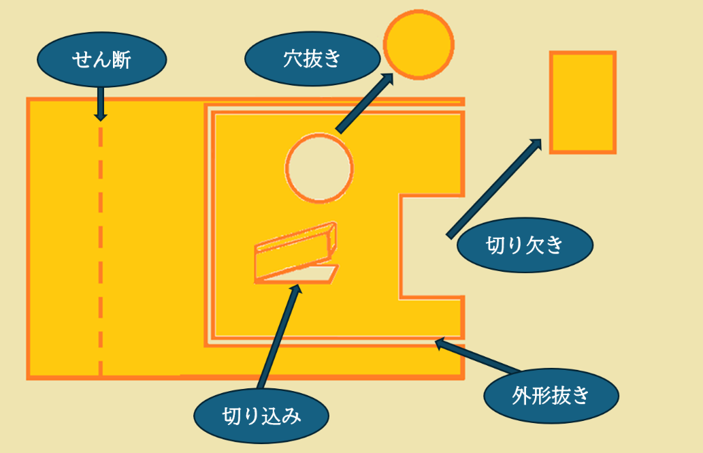
Die-cutting is a processing method that uses a special die to cut a material into a predetermined shape.
To precisely extract the required shape by compressing and shearing the material,
It offers high dimensional reproducibility and is suitable for stable medium-to-large-batch production.
Die-cutting processes include various types such as blanking, hole punching, notching, shearing, and cutting. These are used individually or in combination to create product shapes.
Why is punching out insulating materials so difficult?
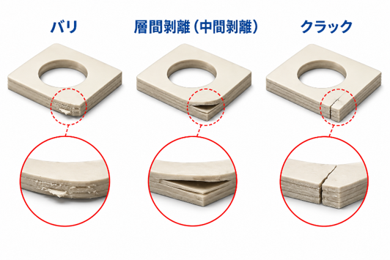
A key characteristic of punched insulating materials is their composite structure, which consists of layers of materials with different hardness and elastic moduli, such as resin layers and glass cloth layers.
Because each layer has a different deformation and fracture timing, stress tends to concentrate between layers during punching.
As a result, irregularities in the fracture surface and minute defects may occur. Furthermore, shear resistance changes depending on differences in material thickness and fiber orientation. Even slightly inappropriate clearance or cutting edge geometry settings can affect machining quality.
Thus, punching insulating materials requires a thorough understanding of the material structure and meticulous design of processing conditions, making it a field that demands experience and technical skill.
What specific problems will occur?
Because the hardness and elongation of the insulating material differ from layer to layer, the stress is not uniformly distributed during pressing.
As a result, the following problems arise:
- Delamination due to interlaminar stress concentration
- Irregular fracture surface and microcracks
- Variation in shear resistance due to fiber orientation
- Burrs and chips due to incompatible clearances
- Processing know-how specific to insulating materials | Technology for achieving high precision?
Especially when considering mass production, even slight differences in cutting edge shape or clearance settings directly affect the stability of machining quality. Cases where "there were no problems in the prototype, but defects occur in mass production" are often due to these unique properties of composite materials.
What is the design of the conditions necessary to achieve high-precision machining?
At YAMADA INDUSTRIES CO.,LTD., we accumulate characteristic data for each material to derive optimal mold designs and processing conditions.
In press forming of insulating materials, the following design considerations are particularly important:
- Optimizing clearances by material type
- Fine-tuning of blade tip angle and shape
- Pressure setting considering plate thickness variations
- Mass production design that anticipates wear and tear
This accumulation of meticulous design conditions enables high-precision machining that suppresses cracking and delamination.
Furthermore, our ability to handle highly difficult-to-process materials such as high-heat-resistant polyimide and special engineering plastics is thanks to our many years of experience and our cumulative track record of processing over 30 billion parts.
Processing know-how specific to insulating materials | Technology for achieving high precision?
The process of punching out insulating materials is significantly different from general metal press processing.
Laminated materials such as glass epoxy and phenolic resin have a composite structure in which a resin layer and a glass cloth layer overlap, and differences in the fracture behavior and elastic modulus of each material greatly affect the processing quality. Therefore, in "insulating material punching," it is essential to design the processing conditions based on an understanding of the material structure, rather than simply punching the material.
Cases where punching is suitable
The advantages of die-cutting are maximized in the mass production of insulating material components.
Features and Benefits
- Dedicated molds enable high-speed and uniform reproduction of identical shapes.
- Stable dimensional reproducibility even for parts requiring high precision.
- Balancing production efficiency and quality
- Optimizing the cutting edge shape and clearance according to the material properties suppresses cracking, delamination, and burrs.
- Preliminary testing during the prototype stage helps prevent problems during mass production startup.
Support for small lot orders
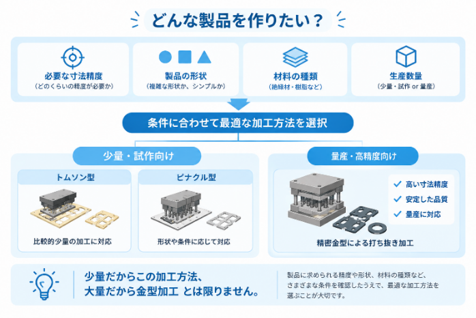
While die-cutting is generally considered suitable for mass production, we can also handle small-lot orders.
Because we design and manufacture our molds in-house, we can quickly start up and make fine adjustments, enabling us to provide high-precision, stable quality die-cutting even for small quantities. Therefore, we can flexibly handle orders from small to large lots, and we can smoothly launch mass production with short lead times.
summary
Punching offers high precision, stability, and efficiency, making it an ideal processing method for insulating parts as it can flexibly handle both small and large lot sizes.
In the die-cutting process for insulating materials, the reproducibility of both "prototype accuracy" and "mass production accuracy" is extremely important.
A major difference here lies in whether or not the molds are manufactured in-house.
At Yamada Manufacturing, we have established an in-house mold manufacturing system where mold design and production are carried out in-house.
As a result,
- Preliminary testing during the prototype stage
– Immediate reflection of fine-tuning data
- Prompt maintenance when wear occurs
– Optimization of conditions during mass production startup
This makes it possible to reliably handle machining that requires high precision.
The reason we can achieve both high precision, mass production, and short lead times is not simply due to our equipment capabilities, but rather our deep understanding of materials and the high level of reproducibility achieved through in-house mold manufacturing.
Compatible insulating materials and resins
Typical materials:
- Phenolic resin
- Glass epoxy
- Polyester-based insulating material
- Polyimide
- Paper phenolic
- Glass cloth laminate
- Special engineering plastics
In addition, we handle a wide variety of difficult-to-process materials, allowing us to accommodate a broad range of materials.
Because insulating materials differ in hardness, layer structure, and susceptibility to cracking depending on the material, it is necessary to design clearances and optimize press conditions according to the material properties.
At our company, we design optimal molds for each material, providing high-precision and stable die-cutting processes.
What we can do
- Insulating materials and laminates (glass epoxy, various resin sheets, etc.)Proposal of the optimal processing method
- Matching the material propertiesMold design and clearance optimization
- moldMaintaining stable quality through in-house design, manufacturing, and maintenance.
- We provide comprehensive support from small-scale prototyping to mass production.
- High-quality die-cutting process that minimizes cracking and delamination.
Short lead times through in-house mold manufacturing.
• All mold design and manufacturing are done in-house.
→ Eliminates the need to wait for outsourcing or make adjustments, significantly shortening the time to launch.
• We can immediately respond to dimensional adjustments and specification changes during the prototyping stage.
→ Mold modifications and fine adjustments can be performed quickly.
• Minimizing lead time from initial development to mass production launch.
• Optimal design is possible according to material properties and processing conditions.
• By suppressing irregularities in cross-sectional quality, we can stably provide high-precision, high-quality die-cutting.
result
- We can handle everything from prototyping to mass production.
- Achieving three key advantages: shorter delivery times, reduced costs, and stable quality.
- We handle orders from small to large quantities, and we can smoothly launch mass production.
- Because we manufacture our molds in-house, we can ensure high precision and peace of mind when transitioning to mass production.
Yamada Manufacturing's Quality Control System
Multi-stage quality control and error handling in the manufacturing process
At Yamada Manufacturing, we ensure quality in terms of dimensions and thickness through process control during the punching of insulating materials, and we verify dimensions and appearance at the initial, intermediate, and final stages of the manufacturing process. Specifically, we perform precise dimensional measurements using a Keyence IM8030 image measuring instrument and visual appearance checks, enabling early detection of abnormalities and correction of processing conditions through quality checks within the process. As a result, we maintain and provide high-precision and stable quality punching from the prototype stage to mass production. In punching, stabilizing conditions within the process is more important than the inspection itself in determining quality.
Preventing defective products from being released through precise inspection in the testing laboratory.
In addition to in-process control, we conduct multifaceted, precise inspections in our testing laboratory to thoroughly manage the defect risks specific to insulating materials.
• Selection of inspection method: Depending on the type of material, hardness, and layer structure, magnifying glass inspection or watermark inspection will be used accordingly.
• Prevention of minor defects: We will not overlook minor defects such as cracks, delamination, and burrs, and will suppress the outflow of defective products.
By combining in-process control and precise inspection in the laboratory, we provide insulating material components that can be used with confidence even in mass production.
Lot-level history management and traceability
Inspection results for each lot are stored as a record, and tracking is possible even after shipment.
This ensures that not only the manufacturing process but also post-shipment quality control and traceability are reliably maintained.
We provide insulating material components that ensure the safety and reliability required by our customers, and can be used with confidence even in mass-produced products.
Utilizing inspection data improves processes and increases production efficiency.
The collected inspection data will be used for trend analysis, process improvement, and production efficiency enhancement.
Through consistent management from prototyping to mass production, YAMADA INDUSTRIES CO.,LTD. provides high-precision, stable-quality punching of insulating materials.
Summary | The key to successful punching of insulating materials is "design capability."
The punching process for insulating materials is a field that requires sophisticated design due to its complex structure.
- Stress control to prevent delamination
- Mold design tailored to material properties
- Ensuring reproducibility from prototyping to mass production.
Whether or not these can be achieved at a high level will determine the quality of the final product.
When considering high-precision mass production of insulating material components, it is crucial to choose a partner who can provide comprehensive support, from material understanding and mold design to mass production reproducibility.
Main Use Cases
- Insulating parts for motors
- Insulating plate inside the control panel
- Battery-related parts
- Insulating components for electrical equipment
- Sliding member
Based in Kariya City, Aichi Prefecture, our products are widely used in the industrial equipment and electrical equipment sectors, including by companies in the Nagoya area.
For example, insulating components for motors require heat resistance and insulation properties, while components inside control panels require precise dimensions.
In battery-related fields, the accuracy of the dielectric strength is crucial for ensuring safety.
For applications other than those listed above, we will consider whether processing is feasible after confirming the materials, shape, and required performance.
Please feel free to contact us for a consultation.
Frequently Asked Questions
Q. Are drawings required?
A. Yes. Since precision is crucial in punching, we basically perform the process based on drawings.
However, we also accept consultations regarding designing shapes based on rough specifications or samples.
Q. Can you handle everything from prototyping to mass production?
A. Yes. We can handle everything from the prototyping stage to mass production launch.
By manufacturing molds in-house, we can maintain a high level of accuracy and reproducibility even when mass production begins.
Q. What materials can be processed?
A. Phenolic resin, glass epoxy, polyester-based insulating material, polyimide, etc.
We can handle a wide range of materials, including special materials and high-temperature resistant engineering plastics.
Other materials are [List page] Please check.
Q. Do we need to supply the materials ourselves, or is it possible to procure them?
A. We can accommodate both.
In punching out insulating materials,
There are cases where the customer provides the materials, and cases where we procure the materials ourselves.
Q. Can I see some examples of our work?
A. Yes. We have materials available showing processing examples for different applications.[Click here for examples of processed products]
Summary | Specialist manufacturer of insulating material punching
YAMADA INDUSTRIES CO.,LTD. is a B2B manufacturer specializing in press punching of insulating materials, with strengths in rapid response and stable quality thanks to in-house mold production. If you have any problems with insulating material processing, please feel free to contact us, whether you are a company in Kariya City, Aichi Prefecture, or the Nagoya area, or in other regions as well.
Contact
For inquiries, please use the "CONTACT" link in the footer at the bottom of the page.
You can contact us via email, LINE, or phone.